This guide answers purchasing and engineering questions using published Shengdong catalogue and model-page data. Examples are not test reports; configuration, test conditions and delivered specifications require project technical confirmation.
How should diesel generator fuel consumption be read?
Read diesel generator fuel consumption with its stated load and power basis, not as litres per hour. The Shengdong 40 kW YC catalogue card lists SD40GF, engine YC4D60-D21, 72 A, 400/230 V, 1500 rpm and 195 g/kW·h at full load. These are published catalogue data, not an hourly fuel-test report.
For an electrical-output-based rate, with matching load and test conditions confirmed, mass flow can be estimated as kg/h = g/kW·h × output kW / 1000. Thus 195 × 40 / 1000 = 7.8 kg/h is only a conditional calculation, not a Shengdong measured result. An engine-shaft-based rate cannot be substituted in this generator-output formula; conversion to L/h also requires fuel density at the relevant temperature.
Do not estimate 25%, 50% or 75% consumption by linearly scaling a full-load value. Caterpillar’s October 2013 white paper explains deposit and wet-stacking risks during extended light-load operation, but it does not establish limits for this YC engine. For an irrigation pump or workshop, request fuel data for the actual model and expected loads; provide daily hours, site temperature and altitude, and follow the installed engine’s maintenance instructions.
Selection note: Project check: provide expected load rate, daily running hours and ambient temperature. Confirm hourly fuel use; include delivery, service and parts in operating costs.
View specification summary: 40kW YC · Jabeck, B. (2013). The Impact Of Generator Set Underloading. Caterpillar.What does bore × stroke mean?
It describes diesel-engine cylinder geometry and helps identify an engine structure or technical version; it is not a stand-alone selection criterion. The KMS 350 kW page lists a Chongqing Cummins NTAA855-G7A, 6/L configuration, 140×152 mm bore × stroke and 1500 rpm.
Selection note: Project check: confirm the engine model, cylinder configuration, rated speed and full table on the model page. Bore × stroke identifies a technical version; it does not replace load sizing.
View full model specifications: KMS 350kWWhich electrical details are needed for a quotation?
Provide prime or standby duty, the load list and starting current, together with destination-country voltage, frequency, phase and connection requirements. The existing 350 kW example lists 400/230 V, 50 Hz and three-phase four-wire Y connection; this must not be copied to another project without confirmation.
Selection note: Project check: list each load with kW/kVA, quantity, motor status and starting method, then state prime or standby duty, 50/60 Hz, phase and destination country.
View full model specifications: KMS 350kWWhy confirm both kW and kVA?
kW is active power and kVA is apparent power: kVA = kW / power factor. The published Shengdong SD350GF KMS example lists 350 kW, COSΦ = 0.8 lagging, 400/230 V and 630 A. At that factor, 350 / 0.8 gives 437.5 kVA as a theoretical conversion, not a new model rating or proof of continuous-duty capacity.
For load demand in kVA, use the load’s power factor; 0.8 is this example’s stated factor, not a default for every installation. Engine-shaft power, alternator capability and load demand are separate checks. Iverson’s Cummins paper explains why motor starting, phase imbalance and nonlinear loads matter. For a factory or pump station, send running power, power factor, starting method, load sequence and voltage/frequency requirements; confirm duty, site temperature and altitude against model documentation and the project technical sheet.
Selection note: Project check: separate continuous running load from the largest simultaneous starting load. Capacity is then confirmed against power factor and starting surge.
Iverson, J. (2007). How to size a genset. Power topic #7007, p. 2. Cummins.Can 50 Hz and 60 Hz be used interchangeably?
Do not assume they are interchangeable. Frequency affects engine speed, alternator, motor loads and control configuration. State the destination grid or equipment requirement before technical confirmation.
Selection note: Project check: lock 50 Hz or 60 Hz before quotation. Do not infer a 60 Hz delivery specification from a page that lists a 50 Hz configuration.
What is needed to select a diesel water-pump set?
Provide medium, flow, head, suction lift, inlet/outlet size, solids or contaminants, run time, site power condition and installation method. Pump diameter or engine power alone is not enough for selection. A diesel-driven water-pump set drives the pump mechanically; a diesel generator for an electric irrigation or well pump supplies its motor. For the latter, send voltage, frequency, rated and starting current, start method and simultaneous loads. If a variable-frequency drive (VFD) is fitted, identify any direct-on-line bypass. Cummins T030 (2015), motor starting and VFDs explains why the start method and drive matter; pump kW alone does not establish a generator rating.
Selection note: Project check: in addition to hydraulic data, state fluid corrosiveness, solids, installation elevation and continuous-duty requirement; these affect pump, engine and control selection.
View selection reference: Diesel Water Pump SetsHow should different 100 kW diesel-generator configurations be compared?
The existing 100 kW page lists WF, YC, WC, KMS, SC and Volvo-series configurations. Each listed sample shows model SD100GF, 180 A output current, 400/230 V output voltage, 1500 rpm rated speed and 195 g/kW·h full-load fuel consumption; weight and dimensions differ. For example, the KMS sample is listed at 880 kg and 2200×860×1371 mm, while the WC sample is 1500 kg and 2500×800×1390 mm. Do not select by “100 kW” alone: confirm prime/standby duty, starting current, destination voltage and frequency, enclosure, ATS and installation space.
Selection note: Project check: identical voltage and current on the 100 kW page do not mean identical dimensions, weight, brand configuration or delivery accessories. Compare installation space, enclosure and controls line by line.
View selection reference: 100kW configurationsWhat should be confirmed before selecting a three-phase diesel generator?
Confirm whether the load needs three-phase supply, the required voltage and frequency, continuous load and maximum starting current. The existing 350 kW KMS page lists 400/230 V, 50 Hz and a three-phase four-wire Y connection. That is one sample configuration, not a default for every power rating or destination. For mixed three-phase and single-phase loads, list the load on each phase; the total generator rating is not capacity available on one phase. Cummins T030, section 3.3.4.3 recommends balanced distribution. Confirm the selected alternator’s unbalanced-load limits and protection settings.
Selection note: Project check: for a three-phase load, state motor quantity, starting method and simultaneous starts, together with destination voltage, frequency and connection requirement.
View full model specifications: KMS 350kWHow is an industrial diesel generator sized?
Do not simply add nameplate kW for industrial loads. Separate continuous running load, the largest simultaneous motor start, and prime or standby duty, then confirm power factor and starting method. The existing 100 kW page lists a 180 A, 400/230 V sample, while the 350 kW KMS sample lists 630 A; capacity must be verified for the project. Provide site altitude and maximum ambient temperature, and ask for the selected set’s available output at those conditions. STAMFORD | AvK, AGN 012 explains alternator environmental ratings; cooling-air temperature inside a canopy may differ from outdoor temperature. Do not apply a universal derating factor.
Selection note: Project check: list running loads, daily hours and the largest simultaneous motor start. Give starting kVA, the starting method and allowed voltage dip; total running kW alone is not enough.
View selection reference: 100kW configurationsHow should open, silent and trailer diesel-generator configurations be chosen?
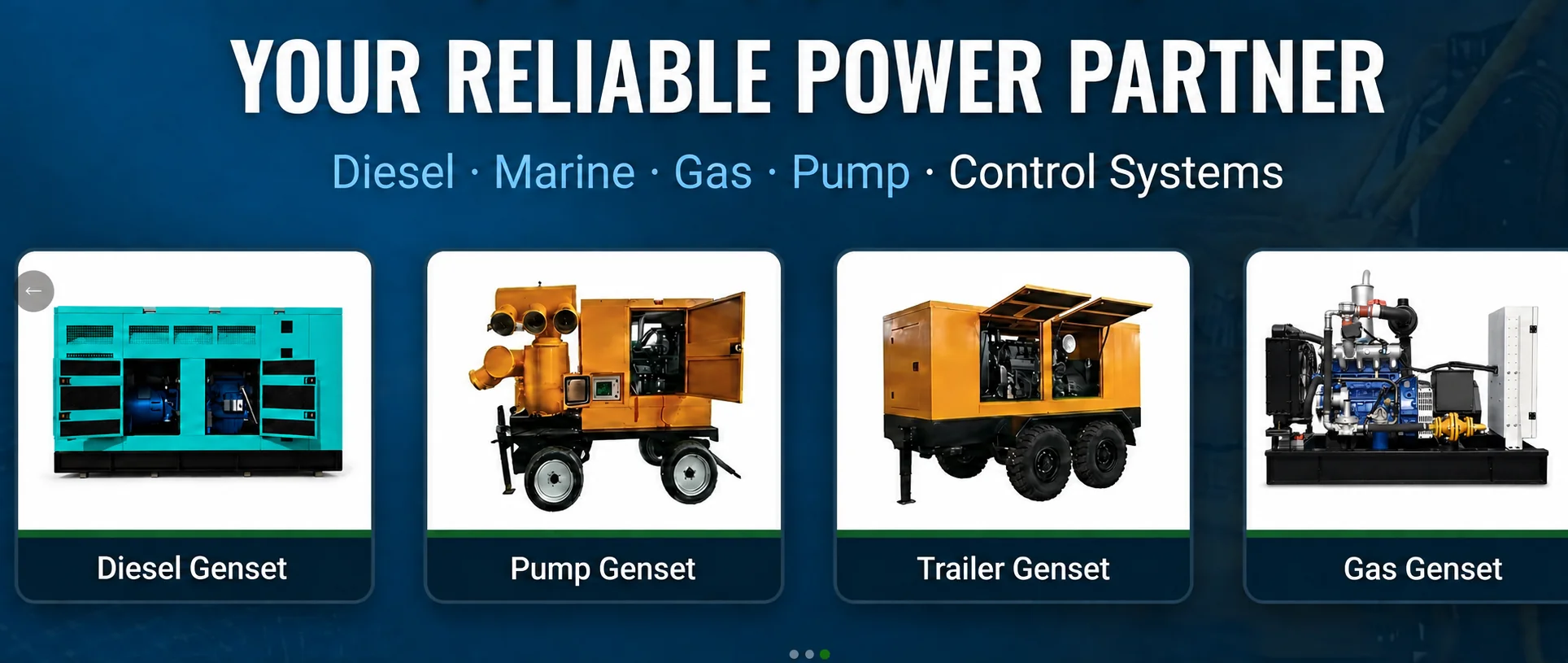
These are installation and delivery configurations, not a model decision made from power alone. Confirm installation space, mobility, site noise limit, weather and dust exposure, fuel runtime and control accessories. The diesel-generator page presents open, silent and trailer options for project discussion; sound level and accessories remain subject to technical confirmation.
Selection note: Project check: choose open, silent or trailer configuration from site installation and transport constraints. Do not assume a sound value or protection level.
View selection reference: Diesel generator configurationsHow do prime, standby and continuous generator ratings differ?
Standby covers interruption of the normal supply; prime supports main-power use under the stated duty conditions; continuous addresses steady base-load operation. These kW allowances are not interchangeable, and a higher figure does not permit long-term use. Record daily and annual hours, average and peak load, site temperature and altitude before selecting the duty rating.
ISO 8528-1 classifies applications and ratings; it does not assign an unstated duty to a Shengdong model. The SD350GF example’s 350 kW output or engine overload entry alone is not a separate standby or continuous rating. Cummins T030, section 2.4 (February 2015), gives manufacturer-specific duty examples, not universal hour or load limits. Confirm assigned engine and alternator duty, site derating and permitted overload in the project technical sheet.
Selection note: Project check: share the load profile, daily and annual hours, outage duty and site conditions. Do not use a standby figure as a continuous-duty promise.
View selection reference: KMS series specificationsWhat gas-quality and supply data should buyers send before requesting a gas generator?
A fuel label such as natural gas or biogas and a target kW rating are not enough to select an engine. Send a recent gas analysis showing composition, lower heating value, methane content, relevant impurities such as hydrogen sulfide and moisture, and the expected variation. Record the pressure, flow and temperature guaranteed at the generator inlet under high demand.
Site altitude, ambient temperature, daily operating hours, emissions limits and heat-recovery plans also matter. Shengdong lists fuel types, heating value and inlet pressure as project inputs, but does not publish one allowable range for every engine. Confirm output, gas treatment and maintenance requirements against the selected engine maker’s fuel specification and site sample.
Selection note: Project check: provide the gas-analysis report and worst-case inlet pressure and flow records. Fuel compatibility and output remain subject to the selected engine’s approved limits.
View selection reference: Gas generator systemsExamples explain how to read specifications only. Final model, configuration, dimensions, weight, fuel consumption and suitability are subject to the project technical confirmation sheet.